
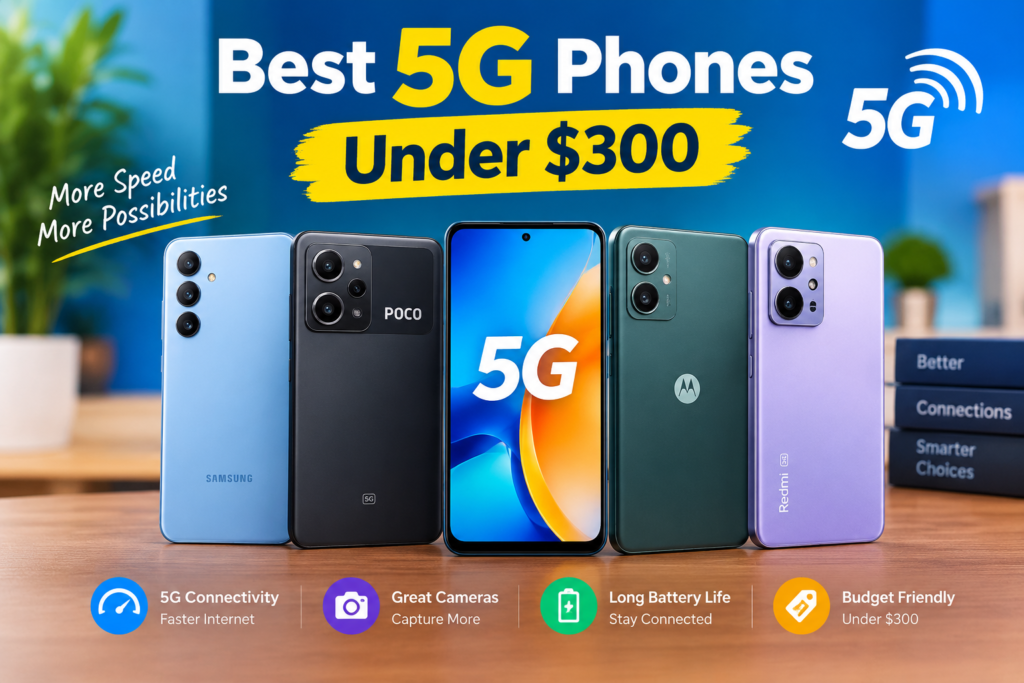
Best 5G Phones Under $300 in 2026
Table of Contents
- What to Expect from a 5G Phone Under $300
- Best Overall: A Balanced 5G Phone
- Best for Battery Life
- Best for Camera Quality
- Best for Gaming
- Best for Display and Entertainment
- Best for Long-Term Value
- Important Features to Compare Before Buying
- 5G Network Compatibility
- Processor and Memory
- Storage Type and Capacity
- Display Brightness
- Software Experience
- How to Choose the Right Phone for Your Needs
- Tips for Getting the Best Deal
- Common Mistakes to Avoid
- Frequently Asked Questions
- Final Verdict
Buying a 5G smartphone no longer requires a premium budget. In 2026, phones under $300 can offer fast mobile connectivity, capable processors, large displays, dependable cameras, long battery life, and modern software features. The challenge is choosing a model that offers the right balance instead of focusing only on the 5G label.
This guide explains what to look for when shopping for a 5G phone under $300 and how to choose the best option for gaming, photography, battery life, everyday performance, and long-term value. Prices and availability can vary by country, retailer, storage option, and promotional offer, so check the current price and network compatibility before purchasing.
What to Expect from a 5G Phone Under $300
A phone in this price range can provide a smooth experience for calls, messaging, web browsing, social media, streaming, navigation, and photography. Many models also include high-refresh-rate displays, generous storage, fast charging, and batteries designed to last a full day.
However, budget 5G phones usually make some compromises. Camera quality may be less consistent in low light, gaming performance may not match a flagship phone, wireless charging is uncommon, and software-support periods can differ considerably. Some models also include unnecessary preinstalled applications or use slower storage.
The best purchase is therefore not always the phone with the highest megapixel count or the fastest advertised charging speed. Look at the complete package: processor efficiency, display quality, update policy, camera processing, battery endurance, build quality, and support for the 5G bands used by your carrier.
1. Best Overall: A Balanced 5G Phone
The best overall phone under $300 should provide dependable performance in every important area. Look for a recent mid-range processor, at least 6 GB of RAM, 128 GB of storage, a bright display, a large battery, and a reliable update policy.
A balanced phone is ideal for people who want one device for work, entertainment, communication, photos, and occasional gaming. It should open applications quickly, keep several common apps available in memory, and remain responsive after months of use.
When comparing balanced models, pay attention to the primary camera rather than the number of cameras on the back. A good main sensor with effective image processing is generally more useful than several low-quality auxiliary cameras. Stereo speakers, NFC, a side-mounted fingerprint reader, and a water-resistant design are also valuable features at this price.
2. Best for Battery Life
If battery endurance is your main priority, choose a phone with a battery capacity of approximately 5,000 mAh or more and an efficient processor. Screen brightness, refresh rate, gaming, navigation, and 5G signal strength can all affect battery life, so capacity alone does not tell the entire story.
A battery-focused phone should comfortably handle messaging, browsing, video streaming, photography, and social media throughout a normal day. Some models can last longer with moderate use, particularly when the display refresh rate is set to an adaptive or standard mode.
Fast charging is another important consideration. A high charging speed can be convenient, but check whether the charger is included and whether the manufacturer uses a proprietary charging standard. Battery health can also be improved by avoiding excessive heat and using an approved charger.
3. Best for Camera Quality
For photography, prioritize the main camera sensor, optical or electronic stabilization, image-processing quality, and the phone’s ability to produce consistent results in different lighting conditions. A 50 MP camera does not automatically produce better images than a lower-resolution sensor.
In daylight, many phones under $300 can capture sharp images with attractive colors. Low-light photography is more challenging, so read reviews that include night scenes, indoor photos, moving subjects, portraits, and video recordings.
Camera software can make a major difference. Useful features may include night mode, portrait mode, HDR, panorama, slow motion, and manual controls. Before buying, check whether the phone can record stable video at the resolution you need and whether the front camera meets your expectations for video calls and selfies.
4. Best for Gaming
Gamers should choose a phone with a modern processor, a high-refresh-rate display, adequate cooling, fast storage, and a battery that can withstand long sessions. A refresh rate of 90 Hz or 120 Hz can make menus and supported games feel smoother, but it does not guarantee high frame rates in demanding titles.
At this budget, casual and competitive games should run well when settings are adjusted appropriately. More demanding games may require medium or low graphics settings. A phone with stable performance over time is often better than one that delivers a brief burst of speed and then throttles because of heat.
Also consider touch response, speaker placement, vibration feedback, storage capacity, and whether the phone has a gaming mode. A case that blocks heat dissipation or a display with poor outdoor visibility can reduce the gaming experience.
5. Best for Display and Entertainment
For watching videos and browsing, look for a bright display with good viewing angles, strong contrast, and a high refresh rate. AMOLED panels usually provide deeper blacks and stronger contrast, while LCD displays can still offer excellent brightness and durability.
Screen size is a personal choice. A larger display is better for video, reading, and gaming, but a compact phone may be easier to hold and carry. Check the resolution as well as the refresh rate, because a smooth display with poor sharpness or weak brightness may still be disappointing.
Stereo speakers, a headphone jack, expandable storage, and wide codec support can make a budget phone more enjoyable for entertainment. If you stream content frequently, confirm that the device supports the video services and digital rights features you use.
6. Best for Long-Term Value
Long-term value depends heavily on software support. Before buying, check how many Android or operating-system upgrades and security updates the manufacturer promises. A phone that costs slightly more but receives updates for longer may be a better investment than a cheaper model with limited support.
Build quality also matters. Look for a sturdy frame, a scratch-resistant front surface, a firm power button, and at least some protection against dust or splashes when available. A removable battery is uncommon today, so battery replacement support and repair availability are worth considering.
Storage is another long-term factor. 128 GB is a practical starting point for many users, while 256 GB is preferable if you take many photos, download videos, or install large games. If the phone supports a memory card, verify whether the card can store applications or only media files.
Important Features to Compare Before Buying
5G network compatibility
Not every 5G phone works with every carrier. Confirm that the model supports the 5G bands used in your country and by your mobile provider. An imported phone may be less expensive but can have incomplete band support, limited warranty coverage, or problems with voice-over-LTE services.
Processor and memory
A newer mid-range processor can be more efficient and better supported than an older high-end chip. For general use, 6 GB of RAM is workable, while 8 GB provides more comfortable multitasking. Virtual RAM features may use storage and should not be treated as a replacement for physical memory.
Storage type and capacity
Fast internal storage improves application loading and system responsiveness. Avoid choosing a model with very limited storage simply because it has an attractive camera specification. Applications, photos, videos, and updates can fill a small storage capacity quickly.
Display brightness
Brightness is important when using a phone outdoors. Manufacturers may advertise peak brightness measured in special conditions, so independent reviews are useful. A display should also offer automatic brightness control that responds smoothly to changing light.
Software experience
Read reviews for information about advertisements, duplicate applications, notification behavior, and system stability. A clean and predictable interface can make a phone feel faster and easier to use, even when two devices have similar hardware.
How to Choose the Right Phone for Your Needs
Start by identifying your top three priorities. If you use your phone mainly for communication and video, prioritize battery life, display quality, and speakers. If you take many photos, focus on the main sensor, stabilization, storage, and image processing. If you play games, compare processor performance, thermal behavior, touch response, and display refresh rate.
Next, decide whether you need a new device from a local retailer or are comfortable buying an imported or refurbished model. A new local model usually offers simpler warranty service and better carrier compatibility. A refurbished phone may offer stronger hardware, but inspect the seller’s return policy, battery condition, repair history, and software-update status.
Finally, compare the total cost. Include the charger, protective case, screen protector, shipping, taxes, and possible storage upgrade. A phone that appears cheaper can become less attractive if essential accessories are sold separately.
Tips for Getting the Best Deal
- Compare prices across authorized retailers and check whether the listed price requires a carrier activation.
- Look for storage and memory differences between apparently identical models.
- Read recent reviews instead of relying only on launch reviews.
- Check the return period and warranty conditions before payment.
- Confirm that the charger, cable, and SIM tool are included.
- Compare the unlocked price with any contract or installment offer.
- Check whether the phone has received recent security updates.
Common Mistakes to Avoid
Best 5G Phones Under $300 in 2026 phone only because it advertises 5G. Coverage, carrier compatibility, processor quality, and software support are equally important. Avoid assuming that more cameras mean better photography, that more megapixels guarantee sharper images, or that a large battery guarantees excellent endurance.
It is also wise to avoid buying a device with an unclear software-update policy. A low price may not be worthwhile if the phone quickly stops receiving security patches. Be cautious with unfamiliar marketplace sellers, especially when the listing does not clearly identify the exact model number.
Frequently Asked Questions
Is a 5G phone under $300 worth buying in 2026?
Yes. Budget 5G phones can provide fast connectivity and strong everyday performance. Choose a model with the correct carrier bands, a recent processor, sufficient storage, and a clear software-support policy.
Can a phone under $300 run games?
Yes. Most current budget 5G phones can run casual games and many popular competitive games. Demanding titles may require reduced graphics settings, and performance can vary depending on heat, storage, and software optimization.
How much RAM should a budget 5G phone have?
At least 6 GB is a sensible target for everyday use, while 8 GB is better for multitasking and gaming. Physical RAM is more important than a manufacturer’s virtual-RAM feature.
Is 128 GB of storage enough?
128 GB is enough for many users who stream media and regularly back up photos. Choose 256 GB if you install many games, record a lot of video, or plan to keep the phone for several years.
Do all 5G phones work with every network?
No. 5G bands and carrier requirements differ by country and provider. Check the exact model number and confirm compatibility with your carrier before buying.
Are budget phone cameras good?
They can be very good in daylight, but low-light photos, zoom, stabilization, and video quality may be limited compared with premium phones. Look for real sample images and reviews from the exact model.
Should I buy a phone with a high refresh-rate display?
A 90 Hz or 120 Hz display can make scrolling and supported games feel smoother. However, brightness, color quality, battery efficiency, and touch response should also be considered.
How long can a phone under $300 last?
With careful use, a quality budget phone can remain useful for several years. Its practical lifespan depends on battery health, durability, storage capacity, performance, and the length of software support.
Is fast charging safe for the battery?
Fast charging is generally safe when using the manufacturer’s charger or a compatible certified charger. Heat is the main concern, so avoid covering the phone or using it heavily in high temperatures while charging.
What should I check after buying a budget 5G phone?
Install available security updates, test the SIM and 5G connection, check the cameras, speakers, microphone, charging port, fingerprint reader, Wi-Fi, Bluetooth, and display. Keep the receipt and confirm the warranty registration requirements.
Final Verdict
The best 5G phone under $300 in 2026 is the one that matches your priorities and works reliably with your network. A balanced model is the safest choice for most people, while battery-focused, camera-focused, gaming-focused, and entertainment-focused phones may be better for specific users.
Before making a decision, compare the complete specification sheet, current software support, real-world reviews, warranty, storage, and network compatibility. By looking beyond the 5G label and headline specifications, you can find an affordable phone that delivers dependable value for everyday use.