
Article Excerpt
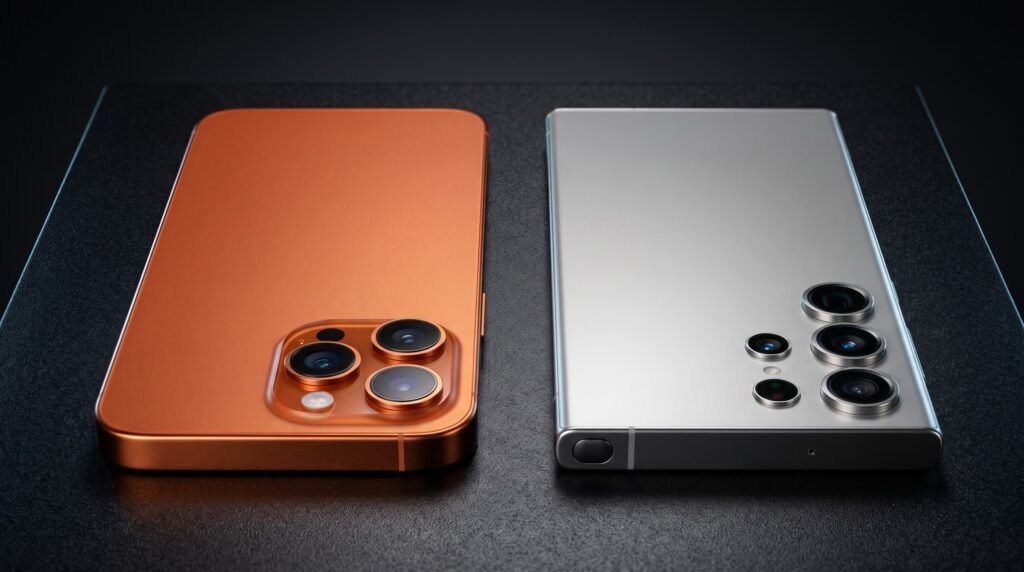
The annual clash between Apple and Samsung reaches a fever pitch with the iPhone 17 Pro Max and Samsung Galaxy S26 Ultra. Focusing on the two most critical buying factors—camera versatility and battery longevity—we break down the sensor physics, computational pipelines, cell capacities, and charging speeds to determine which flagship truly leads.
Table of Contents
iPhone 17 Pro Max vs Samsung Galaxy S26 Ultra: Which Flagship Wins on Camera & Battery?
In the premier tier of mobile technology, Apple and Samsung represent the pinnacle of engineering. While general smartphone processing power has reached a baseline where almost any flagship handles daily workflows effortlessly, the primary purchasing decisions still pivot on two demanding metrics: imaging performance and battery endurance.
The iPhone 17 Pro Max adopts a unified 48MP tri-camera imaging strategy powered by the A19 Pro silicon, aiming for optical consistency across all focal lengths paired with high efficiency. The Samsung Galaxy S26 Ultra counters with an expansive multi-lens suite centered around a 200MP main sensor, dual-telephoto focal lengths, and expansive battery management via the Snapdragon 8 Elite platform.
Deciding which device deserves top billing requires moving past marketing claims and evaluating how sensor physical size, pixel-binning algorithms, chemical cell design, and thermal charging curves behave under rigorous real-world conditions.
Camera Systems Compared: Hardware & Sensor Architecture
The optical philosophy separating these two flagships is distinct: Apple prioritizes sensor uniformity and cross-camera parity, while Samsung champions raw resolution density and long-range optical reach.
  APPLE iPHONE 17 PRO MAX CAMERA ARRAY
  +-----------------------------------------------------------+
  | Main: 48MP (1/1.28", f/1.78, 24mm, 2nd-Gen Sensor Shift)  |
  | Ultra Wide: 48MP (1/2.55", f/2.2, 13mm, Dual Pixel PDAF)   |
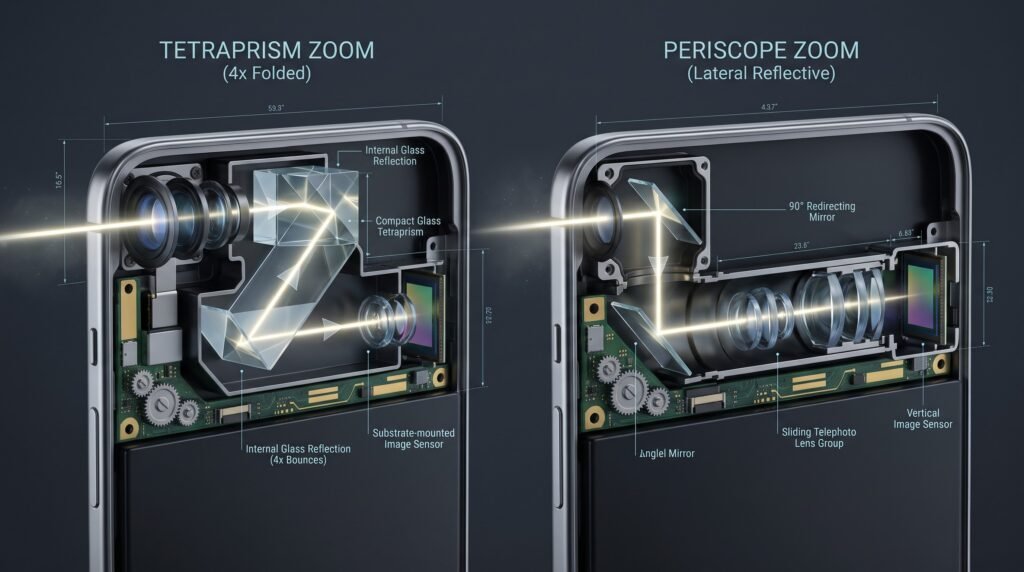
  | Telephoto: 48MP (1/2.55", f/2.8, 100mm Tetraprism 4x/8x)  |
  +-----------------------------------------------------------+

  SAMSUNG GALAXY S26 ULTRA CAMERA ARRAY
  +-----------------------------------------------------------+
  | Main: 200MP ISOCELL (1/1.3", f/1.4 - f/1.7, 24mm, OIS)    |
  | Ultra Wide: 50MP ISOCELL (1/2.5", f/2.0, 13mm, Dual Pixel)|
  | Telephoto 1: 10MP (1/3.52", f/2.4, 67mm 3x Optical)       |
  | Telephoto 2: 50MP Periscope (1/2.5", f/3.0, 115mm 5x)     |
  +-----------------------------------------------------------+
Apple’s Uniform 48MP Foundation
With the iPhone 17 Pro Max, Apple transitioned all three rear modules to 48-megapixel sensors. This design choice solves one of the oldest pain points in multi-camera phones: color cast shifts, resolution drops, and tonal mismatches when switching between lenses. Every lens can output full 48MP ProRAW captures, high-resolution 24MP default composites, or 4K/120fps Dolby Vision video.
Samsung’s 200MP ISOCELL Architecture
Samsung relies on its large 200MP ISOCELL sensor with an ultra-fast aperture. Utilizing a 16-to-1 pixel binning setup, it outputs 12.5MP images composed of 2.24$\mu$m virtual superpixels for standard point-and-shoot scenarios. This sensor acts as both a wide-angle workhorse and an optical 2x digital cropper without noticeable resolution degradation. However, Samsung continues to use an auxiliary 10MP 3x optical module alongside its flagship 50MP 5x periscope, creating an uneven hardware distribution across its zoom ranges.
Daylight Detail & Dynamic Range: 48MP Triple Array vs. 200MP Quad Array
Under bright, optimal daylight illumination, both flagships deliver exceptional clarity, but their approach to texture and color grading takes different paths.
Detail Resolution: In dedicated 200MP mode, the Galaxy S26 Ultra captures incredible resolving power in high-contrast textures—such as architectural stonework, distant foliage, and intricate signage. However, in default shooting modes, Apple’s 24MP default capture profile on the iPhone 17 Pro Max consistently preserves more authentic fine-line micro-contrast without the heavy algorithmic edge sharpening that can appear in Samsung’s One UI processing.
Color Balance and Tonal Mapping: Samsung favors vivid color saturation, lifting shadows aggressively for an instantly shareable, vibrant look. Apple’s Photonic Engine targets realistic skin tones and preserves shadow depth, avoiding flat-lit scenes. Furthermore, Apple’s customizable Photographic Styles alter tone and color balance directly in the pipeline, modifying the sensor’s raw look without compressing dynamic range like standard filters do.
Low-Light Sensitivity, Night Modes, and Noise Floors
When light levels drop, physical sensor dimensions and computational signal-to-noise ratios dictate image clarity.
       LOW-LIGHT NOISE MITIGATION STRATEGIES

  Apple (Photonic Engine / Deep Fusion)
  Multiple 48MP Underexposures ---> Neural Denoising ---> Pristine 24MP Output

  Samsung (Nonacell/Hexadeca Binning + Nightography)
  200MP Array ---> 16-in-1 Physical Charge Summing ---> 12.5MP Superpixel Output
Apple’s Clean Color Pipeline
The iPhone 17 Pro Max benefits from an updated second-generation sensor-shift optical image stabilization system that counteracts hand tremors across multiple axes. Rather than blowing out highlights to make scenes look artificially bright, the Photonic Engine keeps deep blacks intact, resulting in a natural night scene. Its 48MP ultra-wide and telephoto sensors allow night mode exposures to resolve quickly with minimal chromatic noise.
Samsung’s Nightography Muscle
Thanks to its 16-in-1 binning technology and an expansive physical aperture on the main camera, the Galaxy S26 Ultra gathers substantial photon counts in pitch-black environments. It excels in situations with minimal ambient illumination, pulling usable detail out of dark backgrounds. However, when using the smaller 10MP 3x telephoto sensor, low-light images show noticeably higher noise and softer details compared to Apple’s 48MP tetraprism zoom.
Telephoto Optics: Tetraprism vs. Dual Periscope Zoom
Zoom performance is the fiercest camera battleground between these two devices.
OPTICAL ZOOM COVERAGE COMPARISON

Zoom Range:   1x       2x       3x       4x       5x       10x      30x      100x
iPhone:      [Native] [Sensor] -------- [Native] -------- [Crop]  [Digital] -----
S26 Ultra:   [Native] [Sensor] [Native] -------- [Native] [Crop]  [Hybrid]  [Space Zoom]
iPhone 17 Pro Max Zoom: Consistent High Resolution
Apple uses a refined 48MP tetraprism lens system. By utilizing light bouncing through four internal prisms, it provides native 4x optical zoom (approx. 100mm equivalent) while enabling an optical-quality 8x in-sensor zoom (200mm) at 12MP. Because this telephoto module features a full 48MP sensor rather than an older 12MP chip, zoom clarity at 4x through 15x is exceptionally sharp, with smooth depth-of-field separation.
Galaxy S26 Ultra: Long-Range Space Zoom Supremacy
Samsung continues its dual-telephoto approach:
Mid-Range 3x Zoom (10MP): Ideal for classic headshots and portrait framing without stepping back, though constrained by a modest sensor resolution.
Periscope 5x Zoom (50MP): Employs high pixel binning and a periscope prism design, delivering crisp native 5x captures and pristine in-sensor 10x cropping.
Beyond 30x: Samsung remains the undisputed leader in long-range zoom. Between 30x and 100x, AI-assisted computational super-resolution reconstructs text, license plates, and distant architectural details that turn into blurry pixels on the iPhone.
Video Capture: Apple ProRes & Log vs. Samsung 8K Pro Video
In video performance, the gap between Apple and Android competitors has narrowed, but targeted professional workflows still split the two.
| Video Capability | iPhone 17 Pro Max | Samsung Galaxy S26 Ultra | Advantage |
| Maximum Recording Mode | 4K at 120fps (Dolby Vision) | 8K at 30fps / 4K at 120fps | Samsung (Resolution) / Apple (Frame fidelity) |
| Pro Recording Formats | Apple ProRes RAW, Apple Log 2 | Samsung Pro Video, 10-bit HDR10+ | iPhone 17 Pro Max |
| Live Studio Integration | External SSD Recording, Genlock | External USB-C Storage Recording | iPhone 17 Pro Max |
| Cinematic Focus Shifting | Cinematic Mode (4K/30fps with rack focus) | Portrait Video (4K/30fps blur) | iPhone 17 Pro Max |
| Audio Capture | Studio-grade 4-mic array, Spatial Audio | Multi-source Bluetooth / Mic leveling | iPhone 17 Pro Max |
The iPhone Video Dominance: The iPhone 17 Pro Max remains the industry benchmark for video content creators. Recording in Apple Log 2 and ProRes RAW up to 120fps directly to external SSD drives provides professional grading latitude comparable to dedicated cinema cameras. Smooth lens switching during recording without frame drops or exposure jumps remains unmatched.
Samsung’s Strengths: The Galaxy S26 Ultra provides 8K recording on both the main and 5x periscope lenses, making it valuable for cropping into high-resolution footage during post-production. Its optical stabilization features horizontal leveling that locks steady footage even during vigorous handheld running.
Battery Capacity, Cell Chemistry, and Real-World Endurance
Battery life is determined by the balance between chemical cell capacity and the thermal efficiency of the underlying processor.
BATTERY EFFICIENCY OVERVIEW

iPhone 17 Pro Max:
~4,823 - 5,088 mAh (Market Dependent) + A19 Pro 3nm Node
Result: Exceptional idle standby, leading screen-on time in mixed app use.

Samsung Galaxy S26 Ultra:
5,000 mAh Standard Cell + Snapdragon 8 Elite Platform
Result: High endurance in heavy gaming, slightly higher background drain.
iPhone 17 Pro Max: High Hardware/Software Synergy
The iPhone 17 Pro Max packs a battery capacity between 4,823 mAh and 5,088 mAh (varying between physical SIM and eSIM-only models). Combined with the tight integration of iOS and the Apple A19 Pro silicon, standby power drain is near zero. During everyday mixed tasks—such as web browsing, messaging, video playback, and social scrolling—the iPhone sets the standard, routinely reaching 18 to 20 hours of continuous active use.
Galaxy S26 Ultra: Sustained 5,000 mAh Powerhouse
Samsung uses a 5,000 mAh capacity cell. While the high-clocked cores of the Snapdragon 8 Elite can draw more power during intense continuous gaming, the chip’s modern efficiency keeps the S26 Ultra running as an all-day device for heavy business users, easily providing 8 to 10 hours of intense screen-on time.
Charging Speeds: Wired, Wireless, and Thermal Management
Charging performance highlights two very different approaches to battery health and convenience.
0 TO 80% CHARGE CURVE COMPARISON

Battery Charge (%)
100 +---------------------------------------------------------+
    |                                                         |
 80 |              /------------------------------------------| (S26 Ultra: ~30-35 mins)
    |             /                                           |
 60 |            /      /-------------------------------------| (iPhone: ~40-45 mins)
    |           /      /                                      |
 40 |          /      /                                       |
    |         /      /                                        |
 20 |        /      /                                         |
    +-------+------+------+------+------+------+------+-------+
    0       10     20     30     40     50     60     70  Minutes
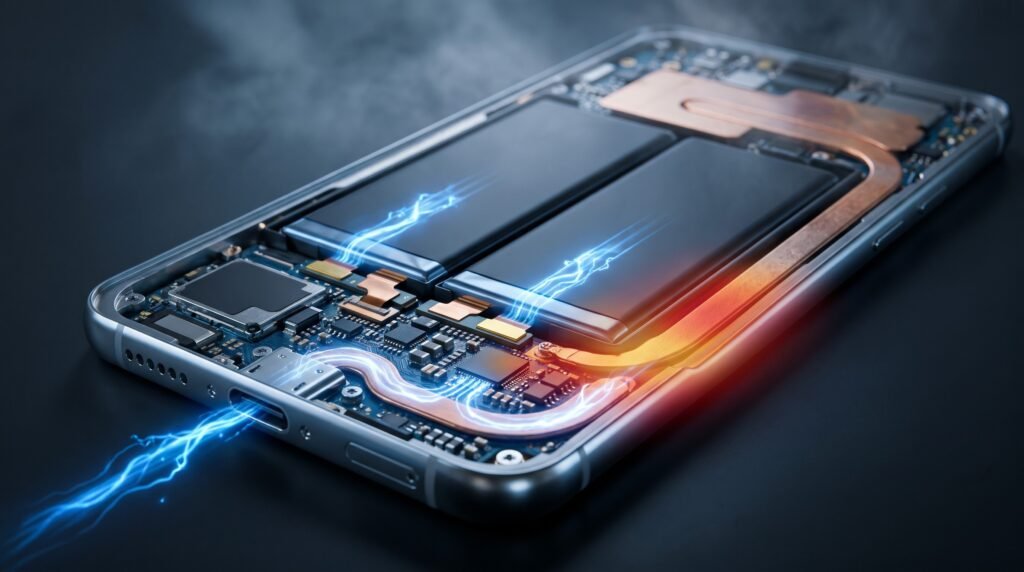
Wired Speeds: Samsung supports faster wired fast charging (reaching 60W), filling the Galaxy S26 Ultra from 0% to 80% in approximately 30 to 35 minutes. Apple supports 40W USB-PD fast charging on the iPhone 17 Pro Max, reaching a 50% charge in about 20 minutes before tapering speeds off sharply to preserve long-term battery cell health.
Wireless Standards: Apple integrates 25W MagSafe and Qi2 charging with secure magnetic alignment built into the phone’s back glass. Samsung also supports 25W wireless charging, but requires magnetic cases to utilize Qi2 accessory rings securely.
Bypass Charging: Samsung includes Bypass Charging (Pause USB Power Delivery), letting users route power directly to the processor during gaming sessions, bypassing the battery completely to avoid heat buildup.
Detailed Camera & Battery Specification Matrix
| Metric / Specification | Apple iPhone 17 Pro Max | Samsung Galaxy S26 Ultra | Category Winner |
| Main Camera Sensor | 48MP Fusion (1/1.28″, $f/1.78$) | 200MP ISOCELL (1/1.3″, $f/1.4$) | Tie (Apple: Consistency; Samsung: Raw Res) |
| Ultra-Wide Lens | 48MP ($f/2.2$, 120° FOV) | 50MP ($f/2.0$, 120° FOV) | Tie |
| Telephoto Configuration | 48MP 4x Tetraprism (8x In-Sensor) | 10MP 3x + 50MP 5x Periscope | iPhone (Mid-tele) / Samsung (10x+) |
| Front Selfie Camera | 18MP Center Stage ($f/1.9$) | 12MP Dual Pixel ($f/2.2$) | iPhone 17 Pro Max |
| Pro Video Encoding | Apple Log 2, ProRes RAW (4K 120fps) | 10-Bit Pro Mode, 8K 30fps | iPhone 17 Pro Max |
| Battery Capacity | 4,823 – 5,088 mAh (Region-dependent) | 5,000 mAh | Samsung Galaxy S26 Ultra |
| Mixed Active Battery Life | 18 – 20 Hours (Active Use Score) | 16 – 18 Hours (Active Use Score) | iPhone 17 Pro Max |
| Max Wired Charging | Up to 40W (50% in 20 min) | Up to 60W (84% in 30 min) | Samsung Galaxy S26 Ultra |
| Bypass Charging Support | No | Yes (Pause USB Power Delivery) | Samsung Galaxy S26 Ultra |
Frequently Asked Questions
Which phone captures better photos of fast-moving subjects and pets?
The iPhone 17 Pro Max holds the edge for moving subjects. Apple’s zero-shutter-lag pipeline and fast readout times on its 48MP main sensor consistently capture fast-moving pets and children without motion blur or shutter lag artifacts.
Does the Galaxy S26 Ultra’s 200MP sensor make files too big?
In default shooting modes, the S26 Ultra uses 16-to-1 pixel binning to output manageable 12.5MP images (around 3 to 5 megabytes each). The full 200MP mode produces files between 50MB and 80MB and is best reserved for landscapes and bright conditions where you plan to crop in post-production.
Can the iPhone 17 Pro Max match Samsung’s 100x Space Zoom?
No. The iPhone 17 Pro Max tops out at 40x digital zoom, and images past 15x show significant soft interpolation. Samsung’s combination of a 5x periscope optic, high-resolution sensor crop, and trained super-resolution AI produces substantially cleaner shots between 30x and 100x.
Which flagship has better battery life when gaming?
Battery endurance during intense gaming is closely matched. The Galaxy S26 Ultra’s vapor chamber cooling and bypass charging let you game indefinitely while plugged in without heating or cycling the battery. On untethered battery power, the iPhone 17 Pro Max delivers slightly better battery drain efficiency per hour in casual-to-mid titles.
Can both phones record video directly to an external SSD?
Yes. Both devices feature high-speed USB-C ports that support external SSD recording. However, Apple’s iOS ecosystem integrates seamlessly with storage drives, supporting ProRes RAW at 4K/120fps direct writes and timecode sync out of the box.
Which device charges faster from dead flat?
The Samsung Galaxy S26 Ultra charges faster over a cable. With a compatible 60W+ fast charger, it reaches 80% charge in about 30 minutes, whereas the iPhone 17 Pro Max takes roughly 40 to 45 minutes to reach the same level.
Does the iPhone 17 Pro Max feature 8K video recording?
No. Apple caps recording at 4K up to 120fps with Dolby Vision. Samsung supports 8K recording at 30fps on its primary and periscope cameras.
Are all three cameras on the iPhone 17 Pro Max 48MP?
Yes. Apple upgraded the entire rear array—Main, Ultra-Wide, and Telephoto—to 48-megapixel sensors, enabling 48MP ProRAW captures across all native focal lengths.
Final Verdict: Which Flagship Wins?
iPhone 17 Pro Max vs Samsung Galaxy S26 Ultra: Smartphones represent the peak of modern mobile engineering, but their strengths serve different priorities:
Crown the iPhone 17 Pro Max the Winner for Video and Point-and-Shoot Consistency: If you are a video content creator, social media professional, or photographer who values optical consistency across every focal length, Apple’s unified 48MP tri-sensor setup, ProRes RAW/Log pipeline, and exceptional standby battery efficiency give it the edge for reliable daily use.
Crown the Samsung Galaxy S26 Ultra the Winner for Zoom Versatility and Fast Charging: If you prioritize extreme long-range telephoto reach (30x to 100x), pro-level manual photo controls, faster 60W wired charging, and bypass charging that protects your battery while gaming or multitasking, the Galaxy S26 Ultra is the ultimate do-it-all hardware suite.